
The shoes come off in September and they mostly stay off until March. That's Queensland. It's also the reason this is the time of year I get more careful, not less, with the people I see for diabetes.
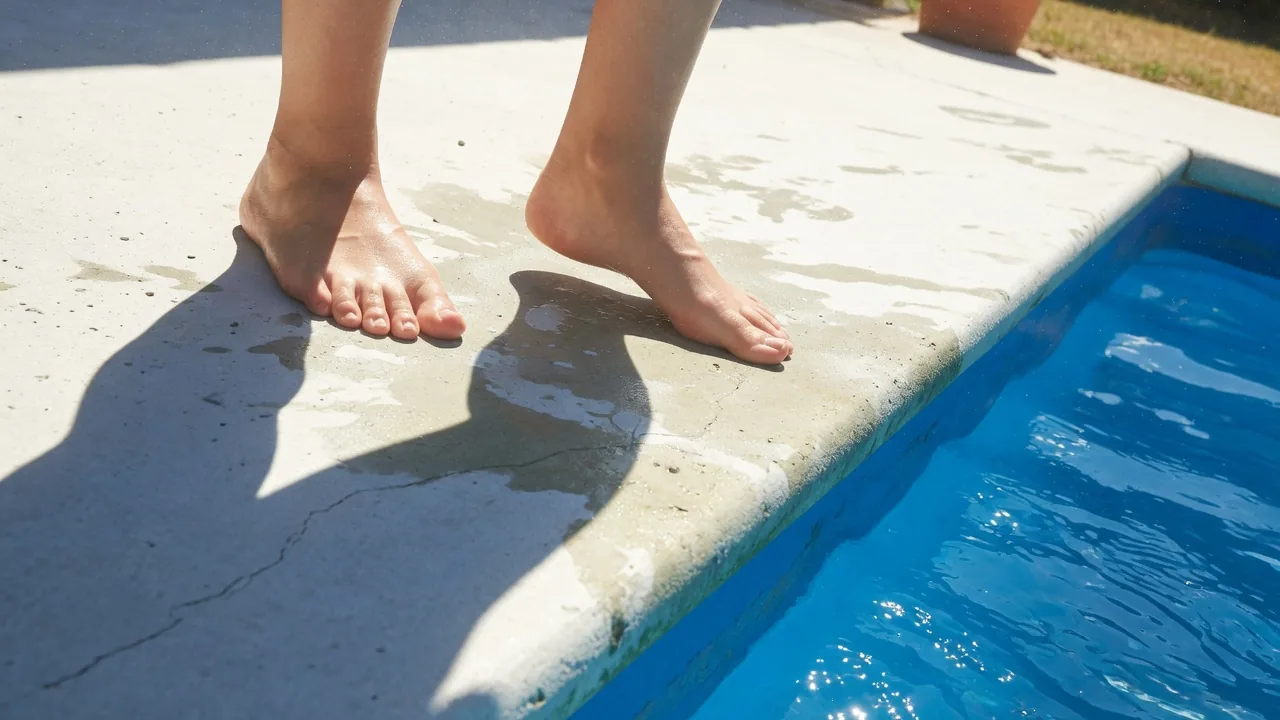
Here's the scenario I talk through with patients, and it's a composite — it's not one person, it's the shape of the thing. Someone walks across the concrete at the pool on a hot afternoon. Bare feet, thirty seconds, nothing dramatic. They don't feel anything, because the nerves in their feet don't report pain the way they used to. That evening there's a blister on the ball of the foot. They don't notice it, because it doesn't hurt. Two days later it's broken open. A week later it's infected.
Nothing in that story required bad luck or carelessness. It just required a foot that can't feel, and a hot footpath.
Why summer is the harder season
Winter is easier because winter has shoes in it. Come spring, a few things change at once:
- Bare feet on hot ground — concrete, sand, pavers, the tray of a boat. Hot surfaces can burn skin, and nerve damage from diabetes means the warning signal may never arrive.
- Thongs and new sandals rub in places closed shoes never touch — between the toes, across the top, around the heel.
- Feet swell in heat, so a shoe that fitted in July is tighter in November.
- Wet feet. Pool, beach, sweat. Damp skin breaks down faster and fungal infection gets a foothold between the toes.
- People are simply on their feet more — walking, gardening, holidays.
None of that is an argument for spending summer in boots. It's an argument for knowing what your feet are doing.
Due for a diabetes foot check? We do them at Caboolture, Beenleigh, Browns Plains and Victoria Point, and we'll tell you plainly where your feet sit.
Book an appointmentWhat diabetes actually does to a foot
Three things, and they stack.
The nerves. Over time, high blood glucose can damage the nerves that carry sensation. People describe it as numbness, pins and needles, burning at night, or feet that feel like they're in socks when they're bare. The dangerous part isn't the odd feeling — it's the missing alarm. Pain is what tells you to take the shoe off.
The blood supply. Circulation to the feet can narrow, so less blood reaches the skin. Wounds that would close in a week on a healthy foot take much longer, and sometimes don't close on their own at all.
The infection risk. Put those two together — a wound you didn't feel arrive, healing slowly — and infection has time and space to take hold.
This isn't a small or unusual problem in Australia. The national guidelines put it at around 50,000 people affected by diabetes-related foot disease each year, 28,000 hospitalisations and 5,000 amputations. I'm not putting those numbers here to frighten anyone. I'm putting them here because almost all of that starts as something small on a foot, and small things on a foot are exactly what a podiatrist is for.
The two-minute check, every day
This is the single highest-value habit, and it takes less time than brushing your teeth. Once a day — end of the day is easiest — look at your feet properly:
- Tops, soles, heels, and between every toe
- Cuts, blisters, cracks, splinters, anything you don't recognise
- Redness, swelling, or an area that feels warmer than the rest
- Colour changes, particularly in the toes
If you can't see the soles, use a mirror on the floor or take a photo with your phone. A phone photo is genuinely useful for another reason — if something does appear, you've got a record of what it looked like on day one.
Alongside that: wash and dry daily, and dry between the toes rather than just over the top. Moisturise dry skin and cracked heels, but not between the toes, where damp skin is the problem rather than the fix. Give shoes a shake out before you put them on. And leave corn removal products on the shelf — the acid in them doesn't know the difference between a corn and the skin around it.
How often your feet should be looked at
The floor is once a year. Everyone with diabetes should have a proper foot check at least annually, whether or not anything hurts.
After that it depends on risk, and the Australian guidelines are specific about it. Using the international risk stratification they adopted, the intervals run roughly every 6 to 12 months at low risk, every 3 to 6 months at moderate risk, and every 1 to 3 months at high risk. What moves you up the scale is things like loss of sensation, poor circulation, foot deformity, a previous ulcer or a previous amputation.
So a fair chunk of a first appointment is simply working out which category you're in — testing sensation, checking pulses, looking at the shape of the foot and at how your shoes are wearing. Once we know that, the follow-up interval isn't a guess. It's the one your risk calls for.
The Medicare bit a lot of people miss
Plenty of people with diabetes don't realise podiatry may be partly covered. A GP can put together a Chronic Condition Management Plan, which allows up to five allied health services in a calendar year with a Medicare rebate, shared across all allied health — so podiatry, physio, dietetics and the rest come out of the same five.
Your GP decides whether you're eligible, so it's a conversation to have at your next appointment. Worth asking. If you've got a plan already, bring the paperwork with you.
Don't wait for a routine appointment if any of this shows up:
- A new wound, ulcer or blister — particularly one that isn't healing
- Redness, heat or swelling spreading up the foot
- Any discharge, or a smell
- A foot or toe changing colour
- A foot wound together with fever or feeling generally unwell
Ring us, your GP, or go to your nearest emergency department the same day. With diabetes, a foot wound is a time-sensitive problem, and nobody has ever wasted my time by getting one looked at early.
Questions I get asked
Can I wear thongs at all?
It's not a flat no, but they're a poor default. They offer no protection from something you stand on, they rub between the toes, and your toes have to grip to keep them on. A supportive sandal with a back strap does the same summer job with far more of the foot covered.
Is walking barefoot on the beach alright?
Sand hides shells, glass and bluebottles, and it gets hot enough to burn. If sensation in your feet has changed, something on your feet is the safer call — even at the beach.
My feet don't hurt. Do I still need a check?
Yes, and this is the one I'd underline. Not hurting isn't the same as not damaged. Reduced sensation means problems turn up silently, which is exactly why the check is scheduled rather than waiting for a symptom.
Can I cut my own toenails?
Many people can, cutting straight across and filing the edges. If you can't see or reach your feet comfortably, if the nails are thick, or if sensation is reduced, it's safer to have it done for you than to risk a nick you won't feel.
What should I bring to the appointment?
The shoes you actually wear most, any care plan paperwork from your GP, and a list of your medicines. Worn shoes tell me more about how you load your feet than almost anything else.
Get ahead of summer. A diabetes foot check covers sensation, circulation, skin and nails, your footwear, and how often we should be seeing you. Clinics across South East Queensland at Caboolture, Beenleigh, Browns Plains and Victoria Point.
Book an appointmentReferences & further reading
- Medical Journal of Australia (2023) — Australian evidence-based guidelines for the prevention and management of diabetes-related foot disease: a guideline summary.
- Diabetes Feet Australia — Australian diabetes-related foot disease guidelines.
- Better Health Channel (Victorian Government) — Diabetes and foot care.
- healthdirect (Australian Government) — Diabetic neuropathy.
- healthdirect (Australian Government) — Foot care.
- healthdirect (Australian Government) — The role of a podiatrist.
- Services Australia — Services available under a GP chronic condition management plan.
This is general information, not individual advice. If you have diabetes, please have your feet assessed by a podiatrist or your GP, and seek care promptly for any new foot wound.