
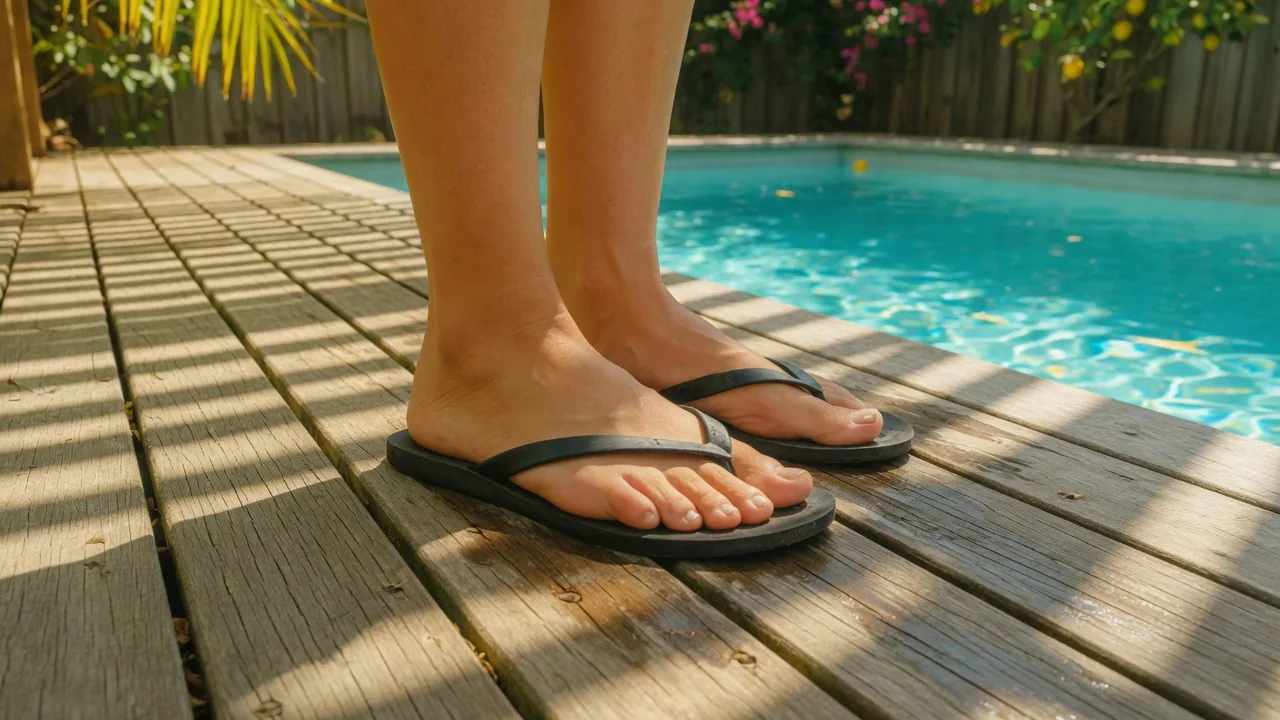
There's a week every September where the weather turns and half of South East Queensland digs the thongs out of the cupboard.
Every year, that same week, my inbox fills up with a particular kind of message. Someone's looked at their feet properly for the first time since about April. A big toenail has gone thick and yellow, maybe a bit crumbly at the end or lifting away from the skin underneath. It's been quietly ignored under socks all winter, and now it's out in the open.
The message is nearly always the same: Can you sort this out before summer?
I want to give you an honest answer, because it isn't the one most people are hoping for — and hearing it now, in September, puts you in a better spot than finding out in December.
First, what's probably going on
A thick, yellow, crumbling toenail is most often a fungal nail infection. The medical name is onychomycosis, and you'll also see it called tinea unguium — tinea of the nail. It's common. Roughly one in ten Australian adults has it at any given time, so if this is you, you're in very ordinary company.
Here's how it usually starts. Fungi love warm, damp, dark places, and the inside of a closed shoe on a Queensland foot is about as good as it gets. Often it begins as tinea on the skin — that itchy, flaky, split skin between the toes — then works its way under the edge of the nail. Once it's in, it's living inside the nail plate: a hard shell with no blood supply. That matters, and I'll come back to it.
Things that make it more likely: sweaty feet in closed shoes, a nail that's taken a knock, shared showers at the gym or the pool, and diabetes or anything that affects your circulation or immune system.
Got a nail you're not happy with? We look at feet properly — not just the nail — at our Caboolture, Beenleigh, Browns Plains and Victoria Point clinics.
Book an appointmentThe bit nobody tells you: the timeline
This is the part I explain at almost every one of these appointments, so let me save you the wait.
A toenail grows about 1 to 1.5 millimetres a month. A whole big toenail takes around 9 to 12 months to fully replace itself. And the damaged section never turns clear again — it can't. With no blood supply, nothing you put on it or take by mouth repairs the nail you're looking at. Treatment stops the fungus so the new nail comes through clean, then you wait while the old part grows off the end.
So the honest answer to "can you sort this before summer?" is usually no — not for the nail you have today. healthdirect puts it plainly: some nail infections take up to 12 months to get better.
Which is exactly why September is a good month to start. Leave it until the week before Christmas and you've lost three months of nail growth you're never getting back.
Before you treat it, make sure it's actually fungus
Here's where I'd push back gently on the internet. A lot of thick, discoloured toenails that land in my chair aren't fungal at all.
An old knock — a dropped weight, a season of football boots half a size too small, years of running in shoes with no room at the front — can permanently thicken a nail and make it look almost identical. So can psoriasis, and so can pressure from a toe sitting under its neighbour. I've seen people spend a year and a fair bit of money on antifungal lacquer for what was only ever a very old bruise.
So the first job is working out what we're dealing with: the nail, the skin, the shoes, the shape of your foot. Where it isn't clear, a small sample can be sent off to confirm it — the lab results take five to six weeks, which is simply how long fungus takes to grow in a dish.
What treatment actually looks like
There's no single answer, and anyone who tells you there's one guaranteed fix is overselling it. What generally makes up a plan:
- Reducing the nail. Thinning a thick nail isn't just cosmetic. It takes the pressure off, stops it catching in your shoes, and gives anything you put on it a chance to reach the infection instead of sitting on a wall of keratin.
- Topical antifungals. The lacquers and solutions from the chemist. They work best on mild infections in the outer part of the nail, and they ask for near-daily consistency for months.
- Tablets. These need a prescription and aren't right for everyone — they interact with some medicines and some people need liver function checked. The research puts the cure rate for the most commonly used tablet at around 76%, which tells you two things: it's the strongest option, and it still isn't a certainty. Your GP is the right person for that conversation, and I'm happy to write to them.
- Treating the skin too. This is the step people skip. Leave the tinea between your toes alone and it simply reinfects the nail.
- Fixing the shoes. If the nail is crushed every day, no amount of antifungal wins. Sometimes general foot care and a change of footwear does more than a bottle of anything.
You can read a plain-language overview of the different antifungal medicines on healthdirect if you like to know what's what before you come in.
Stopping it coming back
Reinfection is the thing that undoes all that patience, and it's mostly won with boring habits:
- Dry properly between the toes, not just over the top of the foot
- Don't wear the same closed shoes two days running — let them dry out
- Wear thongs in communal showers, at the pool and at the gym
- Keep your towel to yourself, and wash socks hot
- Treat the skin, not just the nail, and keep going a little longer than feels necessary
One that's easy to miss: nail tools. Clippers that go through an infected nail and then a healthy one just move the problem along. Clean them, or keep a separate set.
When it's worth booking in
I'd have a look if the nail's getting thicker or starting to hurt, if it's spreading to the nails next door, if it's catching in your shoes, or if a chemist product has had a genuine few months and nothing's changed.
If you have diabetes or reduced circulation, don't sit on it. A thickened nail can press on the nail bed and break the skin underneath, and in a foot that doesn't heal quickly that's a bigger deal than an ugly nail. Coming in early is a large part of what routine foot care is for.
Worth saying too: if the nail hurts at the edge rather than being thick across the middle, that's a different problem — usually an ingrown toenail, treated a completely different way and sorted in a lot less than nine months.
Questions I get asked about this
How long does a fungal toenail take to clear?
Longer than most people expect. A toenail grows roughly 1 to 1.5mm a month, so a full nail takes about 9 to 12 months to replace itself. Treatment has to keep going for that whole growth cycle, because the damaged part never turns clear again — it has to grow off the end.
Are all thick yellow toenails fungal?
No, and it's worth knowing that before you spend money. An old sporting knock, years of pressure from tight shoes, and psoriasis all thicken and discolour a nail in a similar way. That's why we assess the nail — and sometimes sample it — before making a plan.
Can I just use something from the chemist?
You can, and it's a reasonable place to start on a mild infection in the outer part of the nail. Those products struggle when the infection sits deep at the base or the nail is very thick. If a few months of honest daily use has changed nothing, get the nail looked at rather than continuing.
Is it contagious?
It can spread — to your other nails, to the skin of your feet, and in shared wet areas. Drying between the toes, not sharing towels and wearing thongs in communal showers all cut that risk down.
Will it come back?
It can, particularly if the skin infection was never treated or the shoes never changed. That's why the prevention list above isn't filler — it's the half of the job that decides whether you do this once or every few years.
Want it sorted properly, starting now? We'll work out what the nail actually is, thin it down, and put together a plan you can stick to — with realistic timeframes, not promises. Clinics at Caboolture, Beenleigh, Browns Plains and Victoria Point across South East Queensland.
Book an appointmentReferences & further reading
- healthdirect (Australian Government) — Toenail infection: symptoms, diagnosis and treatment.
- healthdirect (Australian Government) — Tinea: symptoms, types and treatment.
- healthdirect (Australian Government) — Antifungal medicines.
- Better Health Channel (Victorian Government) — Nails: fingernail and toenail problems.
- Better Health Channel (Victorian Government) — Tinea.
- Leung AKC, et al. Onychomycosis. StatPearls, NCBI Bookshelf.
This is general information, not individual advice. Nail changes can have several causes, so please have your feet assessed properly by a podiatrist or your GP.