
For something that's only a corner of nail, an ingrown toenail can make a surprising mess of your week. It throbs at work, it hurts when the bed sheet touches it, and you end up wearing thongs to places you really shouldn't. The pattern I see most often is that people have a go at it themselves, get a few good days, and then it comes back worse than before.
Why it happens
An ingrown toenail is when the edge of the nail grows into the skin beside it, which then gets red, sore and sometimes infected. They're very common. A review in American Family Physician estimated they make up about 20% of foot problems seen in primary care, usually on the big toe, with nail-cutting habits and footwear the most common contributors. The usual story in the clinic involves tight shoes pressing the nail into the skin, a naturally curved nail, a stubbed or dropped-on toe, or sweaty feet. Very often it's the way the nail has been cut. Rounding off the corners leaves a little spike that grows straight into the skin.
What helps at home (and what to stop)
For a mild, early ingrown toenail, simple home care can settle it:
- Warm soaks a few times a day to calm the skin down
- Roomy, comfortable shoes so nothing presses on the toe
- Keeping the toe clean and dry
Please don't dig at it. Bathroom surgery with nail clippers and a sewing pin is how a lot of the worst ones I see got that way. Cutting down the side nearly always leaves a hidden spike of nail behind, and every cut is another way in for infection. If the toe is red, hot, throbbing or weeping, get it looked at instead of having another go.
Toe too sore to touch? We treat painful ingrown toenails across South East Queensland at Caboolture, Beenleigh, Browns Plains and Victoria Point, and can often treat it at the first appointment.
Book an appointmentWhen it keeps coming back
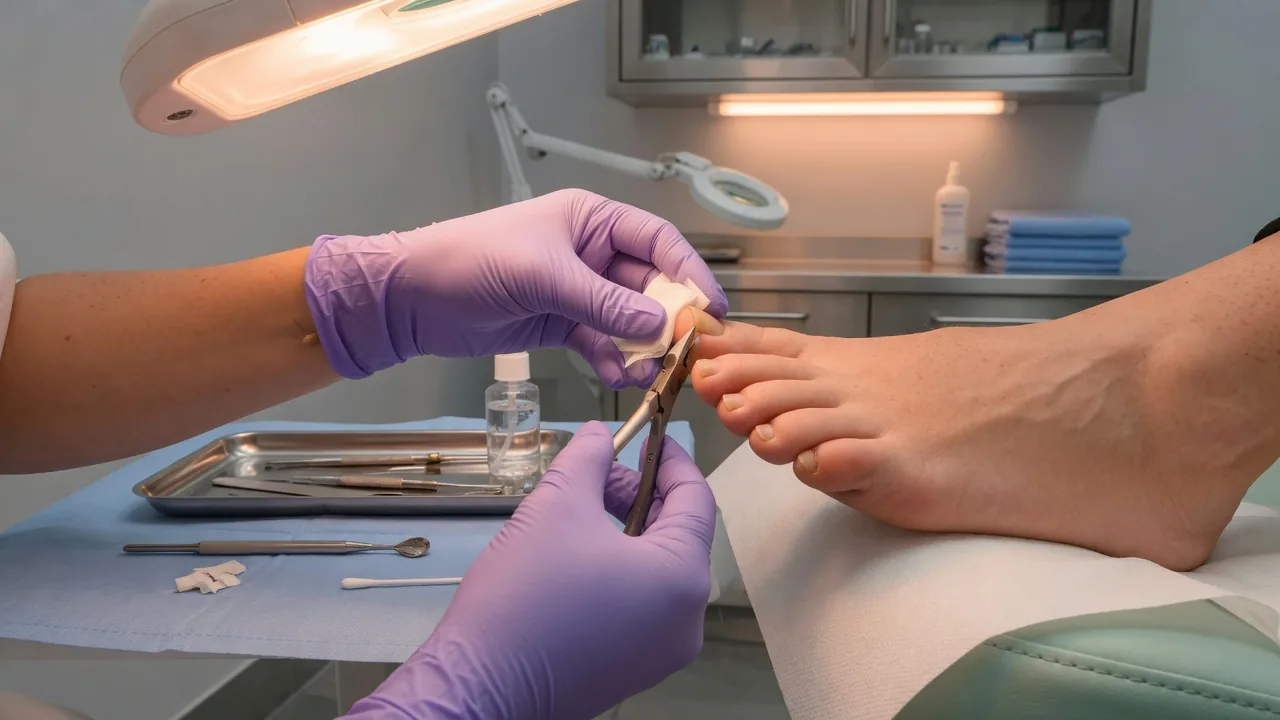
If you're on your third or fourth round with the same toe, it's time to deal with it properly instead of patching it up every few months. In the clinic we can carefully remove the piece of nail that's digging in as part of routine foot and nail care, and for many people that is enough.
For a nail that keeps ingrowing, there's a minor nail procedure. The toe is numbed with local anaesthetic, we remove just the problem edge of the nail, and then treat that narrow strip of nail bed with a chemical (usually phenol) so it doesn't grow back. A Cochrane review found surgical treatment was better at preventing recurrence than non-surgical options. A 2023 meta-analysis in the Journal of Foot and Ankle Research found that adding phenol to the nail bed appears to lower the risk of it coming back, although the authors noted that much of the research is of poor quality. You walk out on your own feet, and we go through the aftercare before you leave.
Common questions about ingrown toenails
How do I treat it at home?
For a mild one: warm soaks, roomy shoes and keeping the toe clean. Don't cut down the side of the nail.
Should I dig it out?
No. That usually leaves a spike of nail behind and risks infection. Let a podiatrist remove it properly.
Does the procedure hurt, and is it permanent?
The toe is numbed with local anaesthetic and it's quick. Treating the nail bed with phenol lowers the chance of that edge growing back, although no procedure can promise it never will.
How do I prevent them?
Cut nails straight across, wear shoes with enough room, keep feet dry, and get a nail that keeps ingrowing looked at.
Sick of the same toe flaring up? We'll settle the sore toe now and, if it keeps coming back, talk you through the longer-term options. Clinics at Caboolture, Beenleigh, Browns Plains and Victoria Point.
Book an appointmentReferences & further reading
- Mayeaux EJ Jr, Carter C, Murphy TE. Ingrown toenail management. Am Fam Physician. 2019;100(3):158-64.
- Eekhof JA, Van Wijk B, Knuistingh Neven A, van der Wouden JC. Interventions for ingrowing toenails. Cochrane Database Syst Rev. 2012;(4):CD001541.
- Exley V, Jones K, O'Carroll G, Watson J, Backhouse M. A systematic review and meta-analysis of randomised controlled trials on surgical treatments for ingrown toenails part I: recurrence and relief of symptoms. J Foot Ankle Res. 2023;16(1):35.
- Vinay K, Narayan Ravivarma V, Thakur V, et al. Efficacy and safety of phenol-based partial matricectomy in treatment of onychocryptosis: a systematic review and meta-analysis. J Eur Acad Dermatol Venereol. 2022;36(4):526-35.
This is general information, not individual advice. If your toe is infected or very painful, please see a podiatrist or doctor.