
I see a lot of sore feet that started with a shoe. Someone grabs a pair off the sale rack because they're a nice colour, or orders their "usual size" online, and a few weeks later they're in the clinic with an aching arch or a grumpy forefoot, wondering what they did.
Here's the thing: footwear is one of the simplest things you can get right for your feet — and one of the most common things people get wrong. So let me walk you through what I actually tell people to look for.
Fit beats everything else
Before you think about brand, price or the latest cushioning tech, get the fit right. The basics of a good fit are surprisingly simple:
- Try shoes on later in the day, when your feet are at their largest — they swell as the day goes on
- Fit both feet, and fit to the bigger one (nearly everyone has one foot slightly larger)
- Leave about a thumb's width (1–1.5 cm) between your longest toe and the end of the shoe
- The shoe should bend where your foot bends — at the ball of the foot, not through the middle of the arch
- The heel should feel held, not sloppy — a firm back to the shoe cradles the heel and stops it slipping
And a good shoe should feel comfortable straight away. If you're being told you'll need to "break them in", that's usually code for "they don't fit".
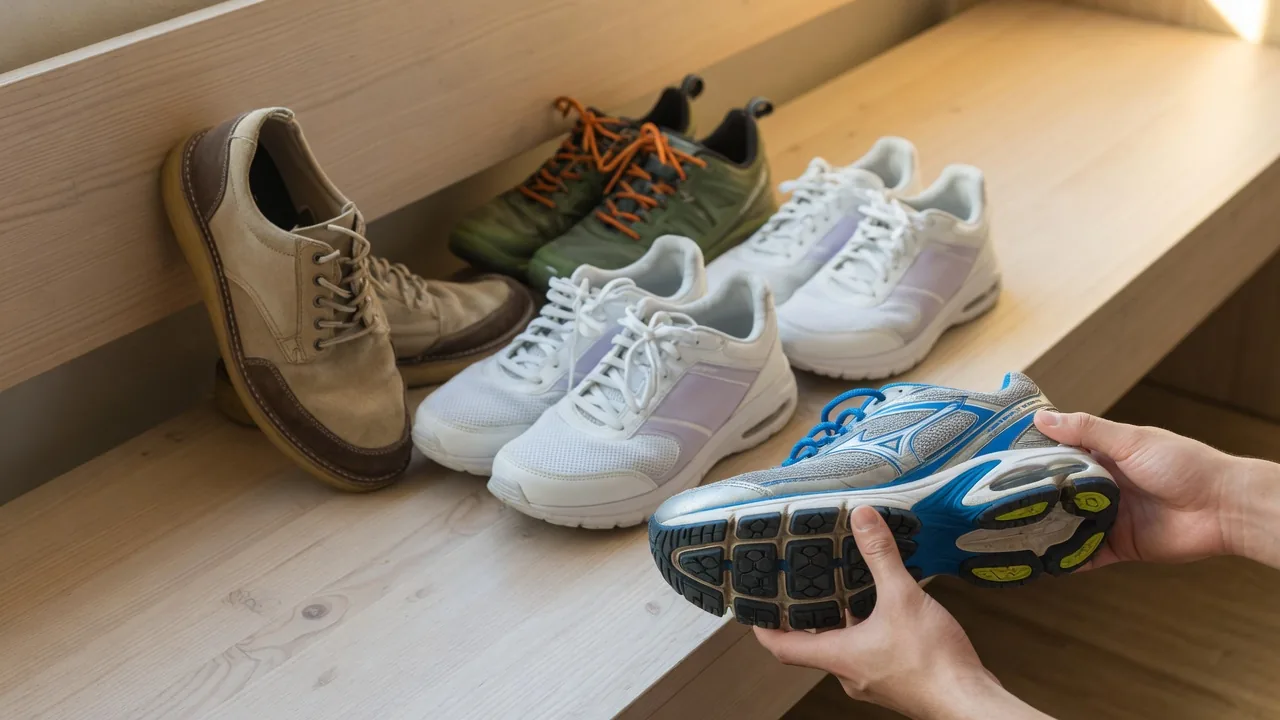
The "right" shoe depends on the job
People often ask me for the one best shoe. There isn't one — it depends on the activity, the surface and how much support you need. A shoe built for running isn't ideal for a day on the tools, and a fashion flat isn't made for a 10 km walk. If you play a sport, a shoe designed for that sport gives you the cushioning and stability it demands.
One tip that surprises people: rotate your shoes. Wearing the same pair every single day loads your feet in exactly the same way and never lets the cushioning recover. Alternating even two pairs spreads that load and lets the foam bounce back between wears.
Not sure what suits your feet? We give footwear advice as part of every assessment, across South East Queensland — Caboolture, Beenleigh, Browns Plains and Victoria Point.
Book an appointmentWhen it's not just the shoes
Sometimes people do everything right — good fit, sensible shoes — and their feet still ache. That's usually the sign that something about your feet is driving it: the way your arch loads, how your foot rolls when you walk, or an old injury. That's where a proper look helps. Depending on what we find, the answer might be a specific style of shoe, a footwear modification, or an orthotic to change how your foot is loaded. If you're a runner, a running assessment shows exactly what your feet do under load and which shoe features actually help you.
None of that replaces good footwear — it works alongside it. And plenty of everyday foot niggles settle once the shoe situation is sorted, which is why it's often the first thing we look at as part of general foot care.
Questions I get about shoes
How much room should there be?
About a thumb's width (1–1.5 cm) past your longest toe, with room to wiggle. Remember your longest toe isn't always the big one.
When should I try shoes on?
Later in the day when your feet are biggest, and fit to your larger foot.
Are dearer shoes better?
Not automatically. Fit and suitability for the job beat price every time.
How often should I replace running shoes?
Roughly every few hundred kilometres, or sooner if the tread's worn, the shoe feels flat, or old aches return.
Feet sore despite "good" shoes? We'll work out what's really going on and get you into footwear that suits you. Clinics at Caboolture, Beenleigh, Browns Plains and Victoria Point.
Book an appointmentReferences & further reading
- Better Health Channel (Victorian Government) — Choosing the right shoe.
- Better Health Channel (Victorian Government) — Footwear for healthy feet.
- healthdirect (Australian Government) — Foot care.
- Australian Podiatry Association — Choosing the right shoe for every activity.
This is general information, not individual advice. If you've got ongoing foot pain, please see a podiatrist so it can be assessed properly.