
My appointment book follows the weather. On the first properly warm weekend everyone digs the thongs out, and a few weeks later I'm looking at heels with splits in them. The same sentence comes out nearly every time: "they've been dry for ages, but this year they've actually cracked."
It isn't bad luck, and it has nothing to do with how clean anyone is. It's partly the season and partly some skin mechanics that most people have never had explained to them.
What's happening to the skin
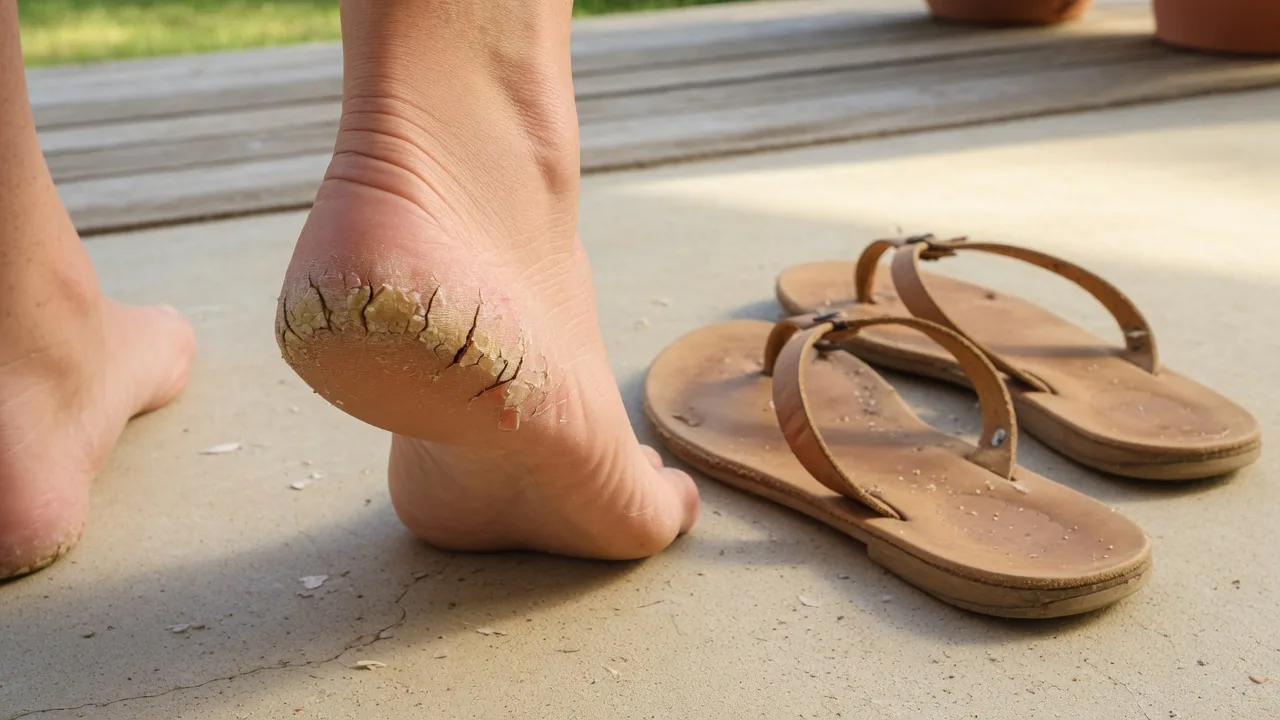
Every time you take a step, the fat pad under your heel flattens and spreads sideways. It's a shock absorber, so that's its job. In a closed shoe the heel counter holds it in and the spread stays small. In a thong, a slide or a backless sandal, nothing holds it, so the pad spreads further and the skin around the rim of the heel has to stretch with it. That's the way I explain it in clinic, and it fits what I see every spring.
Soft, well-hydrated skin copes with that stretch. Dry skin (xerosis) is rough, tight and scaly, and the feet are one of the places it turns up most, because they have few oil glands. When dry skin is also thick, it can't stretch, so it splits. That split is a heel fissure. The thick yellow rim around the edge of the heel looks harmless, but it's usually the part that cracks.
Spring in South East Queensland dries feet out in several ways at once:
- Open-back shoes, so the heel is open to the air all day and spreading with every step
- Bare feet on tiles, concrete and hot decking
- Pool water and salt water, then sand, which works like sandpaper
- Long hot showers and soap, which strip the skin's own oils
- More time on your feet with spring cleaning, gardening and the kids' sport
Some people start with drier skin anyway. Getting older, eczema, an underactive thyroid, diabetes and some medicines can all play a part, and in those people the heels tend to crack faster and deeper.
Heels already split? We can take the thick skin down and dress the cracks in one appointment at Caboolture, Beenleigh, Browns Plains and Victoria Point.
Book an appointmentWhy moisturiser on its own often doesn't work
This frustrates people, and fair enough. They've been putting cream on for a month and the cracks are still there.
The reason is thickness. Once a solid rim of callus has built up around the heel, a light cream softens the top millimetre or two and not much more. The hard layer underneath doesn't change, and that's the layer that splits. Trying to moisturise through several millimetres of callus is a bit like watering the lawn through a tarp.
So there are two jobs, and the order matters.
First, take the thickness down. In the clinic the hard skin is pared back with a sterile blade, and the edges of the fissures are tidied so they can close instead of catching and tearing open again. Callus itself has no nerve supply, so most people find this comfortable, and a lot of them say their heels feel lighter walking out. If a crack is deep, we'll dress it or strap it so the edges hold together while it heals.
Second, keep the skin hydrated so it doesn't build straight back up. This part is yours, every day, and the product matters. I usually suggest a urea-based heel balm. Most of the ones at the chemist sit somewhere between 10% and 25% urea. Urea is part of the skin's own moisturising system. It draws water into the outer layer and, at higher strengths, softens and loosens hard skin, which a plain sorbolene doesn't do. A systematic review from the University of South Australia found urea is the most studied ingredient for dry feet. To be fair to the evidence, the authors also found most of those studies were poor to moderate quality, so nobody can say one cream is clearly better than all the others. In one randomised trial in people with type 2 diabetes and very dry feet, a urea-based cream did better than a glycerol-based one.
How to use it:
- Once or twice a day, every day. If you only manage one, make it the night one
- Heel, rim and sole. Not between the toes, where damp skin is the problem
- Put it on slightly damp skin, straight after a shower
- Give it a week or two before you decide whether it's working, because skin turns over slowly
What to do about your shoes
I'm not going to tell a Queenslander to wear boots in October. But if your heels crack every year, your footwear is part of the reason, and there's a middle ground.
- A sandal with a back strap does the same summer job as a thong and holds the heel in a lot better
- Some cushioning helps. A thin, hard sole on hard ground is the worst combination for the heel pad
- Going barefoot on tiles all day is the same problem as a thong without the sole. Even a pair of supportive slides around the house makes a difference
- If you're on your feet for work, what you stand in is doing more to your heels than anything you put on them at night
Anything that keeps the heel fat pad where it belongs is on the right track. It's the same thinking behind orthotic therapy when someone has heel pain and cracked heels at the same time.
Things I'd ask you not to do
- No blades, callus shavers or cheese-grater tools at home. They take off too much, too quickly, and I see the results of a slip more often than I'd like. A foot file or pumice on damp skin, lightly and a bit at a time, is fine for most healthy adults.
- No corn or callus acid pads. The acid can't tell the hard skin from the healthy skin next to it.
- Don't pick at the loose flaps. Tearing them takes live skin with them, and that's how a crack turns into a wound.
When it isn't just dry skin
Most cracked heels are exactly what they look like. A few aren't:
- Tinea. Dry, scaly, slightly itchy skin across the sole and up the sides of the foot (the "moccasin" pattern) is one of the recognised forms of tinea pedis, and moisturiser won't fix a fungal infection. Tinea can also spread into the toenails, which is a longer job again.
- Psoriasis or eczema. These tend to look like well-defined, silvery or inflamed patches, often with the same thing going on elsewhere on the body.
- Diabetes. A cracked heel is a break in the skin, and with diabetes any break in the skin needs more care. The international diabetes foot guidelines recommend moisturising dry skin and not using chemical agents or plasters to remove callus, and having a professional do the sharp work. If that's you, our summer diabetes foot post covers the rest of it.
Get a cracked heel looked at the same day if:
- It's bleeding, or deep enough that you can see into it
- There's redness, heat or swelling spreading around it
- There's any discharge or smell
- It hurts to walk on, rather than just being uncomfortable
- You have diabetes, poor circulation, or reduced feeling in your feet
An open fissure is a wound with a direct route into the tissue underneath. Most are simple to treat early and a lot less simple once they're infected.
Questions I get asked
Will the hard skin just come back?
Some of it, yes. Callus is how skin responds to load, and you're still walking. The aim is to keep it thin and soft enough that it doesn't split, and that's what the daily cream is for. Most people settle into a review every few months over summer and look after it themselves in between.
Does soaking my feet help?
A short soak softens the skin before filing. Long soaks can leave feet drier afterwards, because the water washes away the oils that hold moisture in. Soak briefly if it helps, then moisturise while the skin is still damp.
Is it because I don't drink enough water?
Probably not, or at least not mainly. Heel skin dries out from the outside (air, friction, hot water, soap, the ground) and thickens from load. Drinking water is good for you, but it won't fix a callused heel on its own.
Can I wear thongs at all?
Of course. Just don't make them the only thing you own. If your heels crack every spring, swapping to something with a back strap on the long days is the easiest change to make.
Does it hurt to have them treated?
Most people find it comfortable. The thick skin has no nerve supply, so reducing it feels a bit like having your nails cut. Deep cracks can be tender at the edges, so we work around those and dress them.
Start summer with heels that aren't splitting. We reduce the hard skin, dress any open cracks, and set you up with the right cream and footwear. Clinics across South East Queensland at Caboolture, Beenleigh, Browns Plains and Victoria Point. See what's involved in general foot care.
Book an appointmentReferences & further reading
- Parker J, Scharfbillig R, Jones S. Moisturisers for the treatment of foot xerosis: a systematic review. J Foot Ankle Res. 2017;10:9.
- Piquero-Casals J, Morgado-Carrasco D, Granger C, et al. Urea in dermatology: a review of its emollient, moisturizing, keratolytic, skin barrier enhancing and antimicrobial properties. Dermatol Ther (Heidelb). 2021;11(6):1905-1915.
- Federici A, Federici G, Milani M. An urea, arginine and carnosine based cream (Ureadin Rx Db ISDIN) shows greater efficacy in the treatment of severe xerosis of the feet in type 2 diabetic patients in comparison with glycerol-based emollient cream: a randomized, assessor-blinded, controlled trial. BMC Dermatol. 2012;12:16.
- Gade A, Matin T, Rubenstein R. Xeroderma. StatPearls. Treasure Island (FL): StatPearls Publishing; 2023.
- Leung AK, Barankin B, Lam JM, et al. Tinea pedis: an updated review. Drugs Context. 2023;12:2023-5-1.
- Bus SA, Sacco ICN, Monteiro-Soares M, et al. Guidelines on the prevention of foot ulcers in persons with diabetes (IWGDF 2023 update). Diabetes Metab Res Rev. 2024;40(3):e3651.
- Australian Podiatry Association. Foot health resources.
This is general information, not individual advice. If a crack in your heel is bleeding, painful or infected, or if you have diabetes or reduced circulation, please have it assessed rather than treating it at home.