
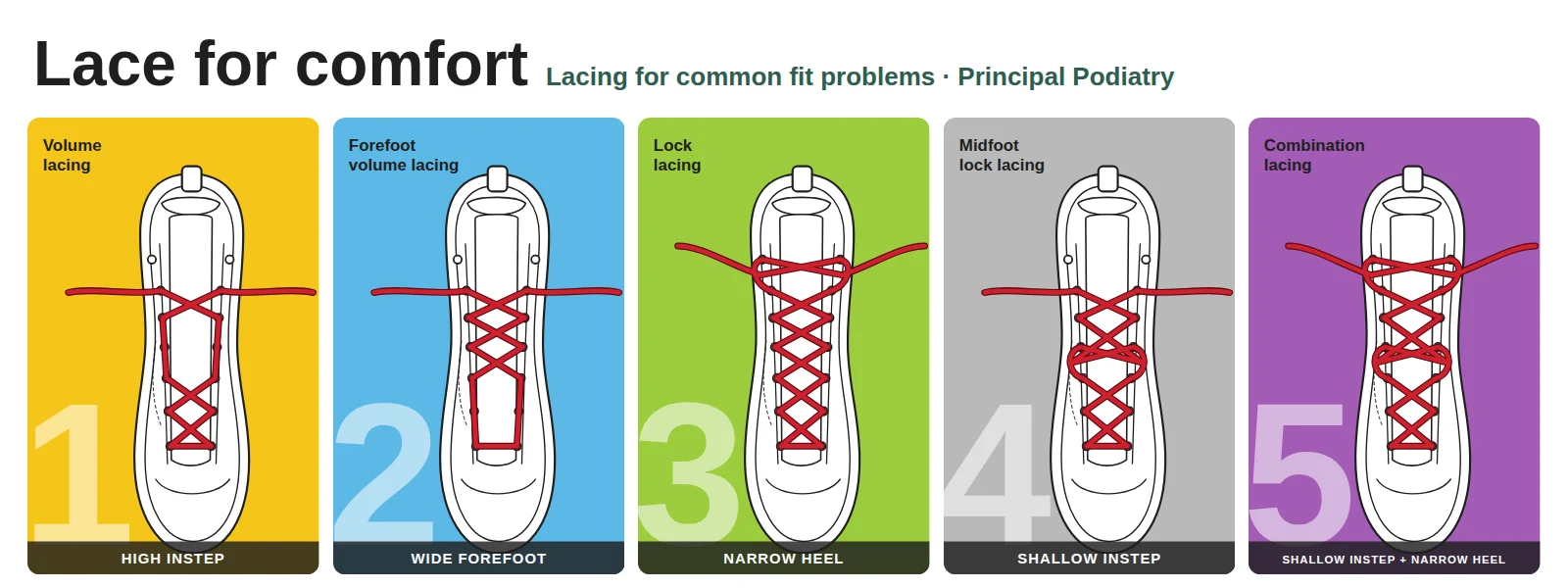
For most runners, a normal criss-cross, snug but not tight, is all the lacing you need. If you have a high instep, a wide forefoot, a narrow heel or a shallow instep, there's a lacing method for each. The chart below shows all five, and each one has its own diagram and steps further down.
Most weeks a runner sits in my room, takes off good running shoes, and the laces are still threaded the way they came out of the box. The top eyelet, the one that sits a little further back near the ankle, has never been used. Then they pull the shoe off without untying it, so the heel isn't held well either.
Summer makes this worse. Feet swell in the heat on long runs, and laces that felt fine on a cool July morning can pinch across the top of the foot by December. Our post on swollen feet in the heat explains why.
What the research says (there isn't much)
I'll be straight with you. Lacing has had very little research. What exists is small lab studies on healthy runners, and none of them show that a lacing pattern prevents injury.
- A German study of 20 runners found that lacing tighter and using all seven eyelets lowered impact loading rates and peak pressure under the heel compared with standard six-eyelet lacing. Comfort was about the same.
- A follow-up from the same lab found seven-eyelet lacings felt more stable without feeling less comfortable. It also found the highest pressure on top of the foot sits over the ankle bones, the arch and the line of the big toe.
- A Dutch walking study found that looser laces meant more heel slipping and more load under the toes.
- A 2025 Spanish study of 24 recreational runners found heel-lock lacing felt more comfortable than plain criss-cross, and the feet ran a little cooler after 20 minutes.
Taken together, a foot held firmly in the shoe without pressure points seems to work better. The patterns below come from clinic experience, not from trials.
Shoes rubbing, slipping or pinching on your runs? We'll look at your feet, your shoes and how you lace them. Clinics at Caboolture, Beenleigh, Browns Plains and Victoria Point.
Book an appointment1. Volume lacing for a high instep
The instep is the top of your foot, between the ankle and the toes. If yours sits high, the laces press right on it. People tell me the top of the foot aches, or they get pins and needles in the toes halfway through a run. Volume lacing leaves a gap with no lace crossing over the high point, so the pressure comes off.
- Criss-cross as normal until you reach the eyelet just below the high, sore part of your foot.
- Run each lace straight up its own side for two eyelets, without crossing.
- Criss-cross the rest of the way and tie.
2. Forefoot volume lacing for a wide forefoot
A wide forefoot gets squeezed across the ball of the foot and the toes. That can rub the sides of the foot, or leave the toes numb. This pattern runs the lace straight up the sides over the forefoot, so the front of the shoe can open up. You still get a firm hold higher up.
- Start with a straight bar across the bottom pair of eyelets.
- Take each end straight up its own side, skipping the next eyelet.
- From there, criss-cross to the top as normal.
Lacing can't fix a shoe that's too narrow. A La Trobe University review found that between 63 and 72% of people in the studies it looked at wore shoes that didn't fit the width or length of their feet. If you need this pattern in every pair, read our guide to choosing the right shoes and try a wider fit. With bunions, a La Trobe study of women with painful bunions found the shape of their usual shoes wasn't linked to the pressure on the bunion. The lacing may feel better, but it won't change the bunion.
3. Lock lacing for a narrow heel
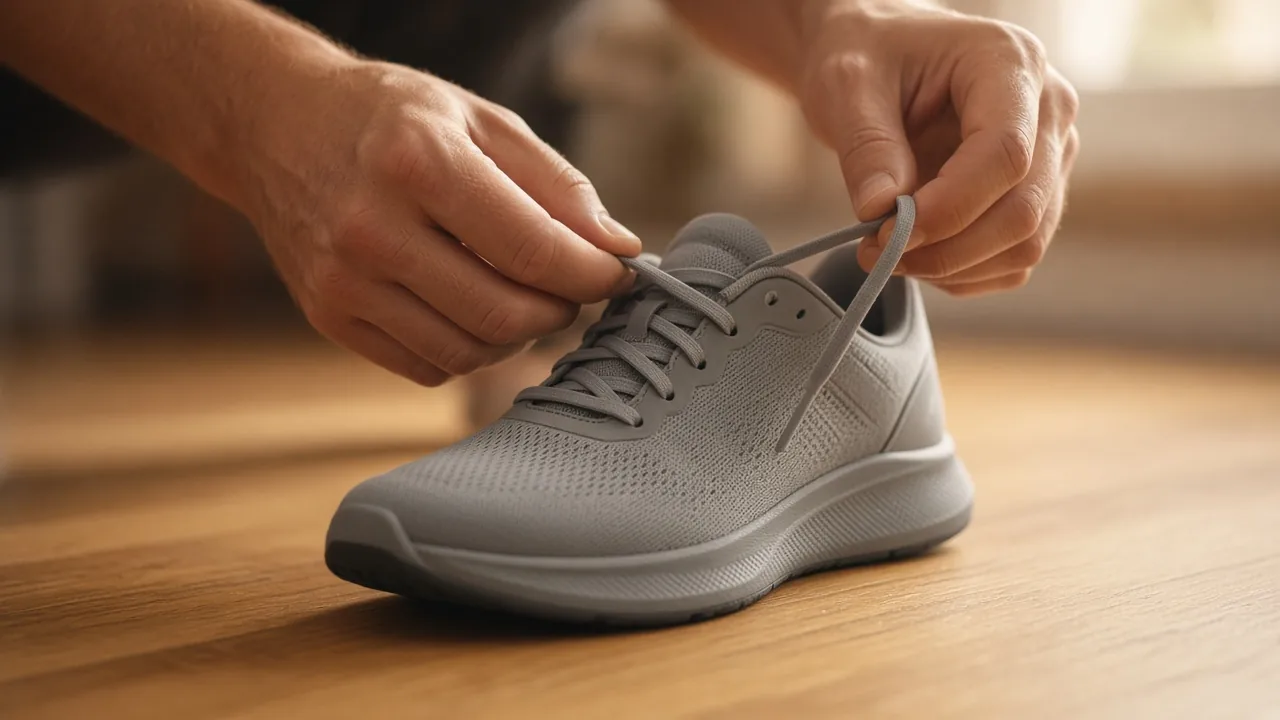
This is the one I show people most. It suits a narrow heel that lifts out of the shoe with each step. Orthotics or heel wedges can lift the heel higher in the shoe and make the slipping worse. A loose heel also lets the foot slide forward on downhills, and toes that hit the front of the shoe are a common cause of black toenails. The lock uses that extra top eyelet near the ankle that most people never touch.
- Lace your usual criss-cross up to the second-top eyelet.
- Take each lace straight up the same side and in through the top eyelet, leaving a small loop.
- Cross the ends over and thread each one through the loop on the opposite side.
- Pull down and back to snug the heel in, then tie as normal.
4. Midfoot lock lacing for a shallow instep
The opposite of a high instep. A low, flat top of the foot leaves room in the shoe, so the foot moves around even with the laces pulled tight. A lock halfway up the shoe holds the middle of the foot down. It's handy in court sports like netball, tennis and basketball, where you change direction a lot and need the shoe to hold you side to side.
- Criss-cross up to about halfway.
- Take each lace straight up its own side into the next eyelet, leaving a small loop.
- Cross the ends over and thread each one through the loop on the opposite side, then pull snug.
- Criss-cross the rest of the way and tie.
5. Combination lacing for a shallow instep and a narrow heel
Some feet have both: a low instep and a narrow heel. The shoe feels roomy in the middle and the heel still slips. Combination lacing puts a midfoot lock and a heel lock in the same shoe.
- Do the midfoot lock from method 4.
- Criss-cross up to the second-top eyelet.
- Finish with the heel lock from method 3, then tie.
What about plantar fasciitis?
"Shoe lacing for plantar fasciitis" gets searched a lot. No study has tested lacing as a treatment for it. A heel lock that stops your foot sliding about lets the shoe's cushioning and support do their job. Heel pain that hangs around needs more, like a look at load, calf strength, footwear and sometimes orthotics. Our heel pain guide covers it. Laces won't fix pain on the outside of the knee either. For that, see our post on ITB syndrome in runners.
When it's not the laces
If you've tried a couple of these and the shoe still slips, rubs or pinches, it's probably the wrong shoe, the wrong size, or something about the way you run. A running assessment is the next step. We watch you run and check your shoes and feet.
Questions I get asked about this
What is the best way to lace running shoes?
For most runners, a normal criss-cross with a heel lock at the top. Snug, not tight. Only change it if something bothers you.
How do I stop my heel slipping in my running shoes?
Use lock lacing (the heel lock or runner's loop) in method 3. If the heel still slips, the shoe may be the wrong size or shape.
What is volume lacing?
Lacing for a high instep. The lace runs straight up the sides over the high part of the foot instead of crossing it, so nothing presses on that spot.
Can changing how I lace my shoes help plantar fasciitis?
No research has tested it. Firm, even lacing helps the shoe do its job, but heel pain usually needs a proper plan. See a podiatrist if it lasts more than a few weeks.
How tight should running shoe laces be?
Your heel shouldn't lift and your foot shouldn't slide, but you should fit a finger under the laces with no pressure or tingling. Loosen them a little on hot days.
Getting ready for summer running? Bring your shoes to your appointment. We'll check the fit, show you the lacing that suits your feet, and look at anything that's been niggling. Clinics at Caboolture, Beenleigh, Browns Plains and Victoria Point across South East Queensland.
Book an appointmentReferences & further reading
- Hagen M, Hennig EM. Effects of different shoe-lacing patterns on the biomechanics of running shoes. J Sports Sci. 2009;27(3):267-75. doi:10.1080/02640410802482425.
- Hagen M, Hömme AK, Umlauf T, Hennig EM. Effects of different shoe-lacing patterns on dorsal pressure distribution during running and perceived comfort. Res Sports Med. 2010;18(3):176-87. doi:10.1080/15438627.2010.490180.
- Fiedler KE, Stuijfzand WJ, Harlaar J, Dekker J, Beckerman H. The effect of shoe lacing on plantar pressure distribution and in-shoe displacement of the foot in healthy participants. Gait Posture. 2011;33(3):396-400. doi:10.1016/j.gaitpost.2010.12.011.
- Sánchez-Jiménez JL, Sánchez-Ribes E, Priego-Quesada JI, et al. Sex differences in young adults on comfort and foot skin temperature using different running shoes lacing. Appl Ergon. 2025;130:104660. doi:10.1016/j.apergo.2025.104660.
- Buldt AK, Menz HB. Incorrectly fitted footwear, foot pain and foot disorders: a systematic search and narrative review of the literature. J Foot Ankle Res. 2018;11:43.
- Bajraszewski KJ, Lim PQX, Buldt AK, et al. Footwear toe-box shape and medial forefoot pressures in women with hallux valgus. J Foot Ankle Res. 2025;18(2):e70041.
This is general information, not individual advice. If you have ongoing foot or leg pain when you run, please see a podiatrist or your GP.