
Every year, somewhere around late November, the same phone call starts coming in. "My heel is killing me first thing in the morning. I haven't done anything to it. It just started."
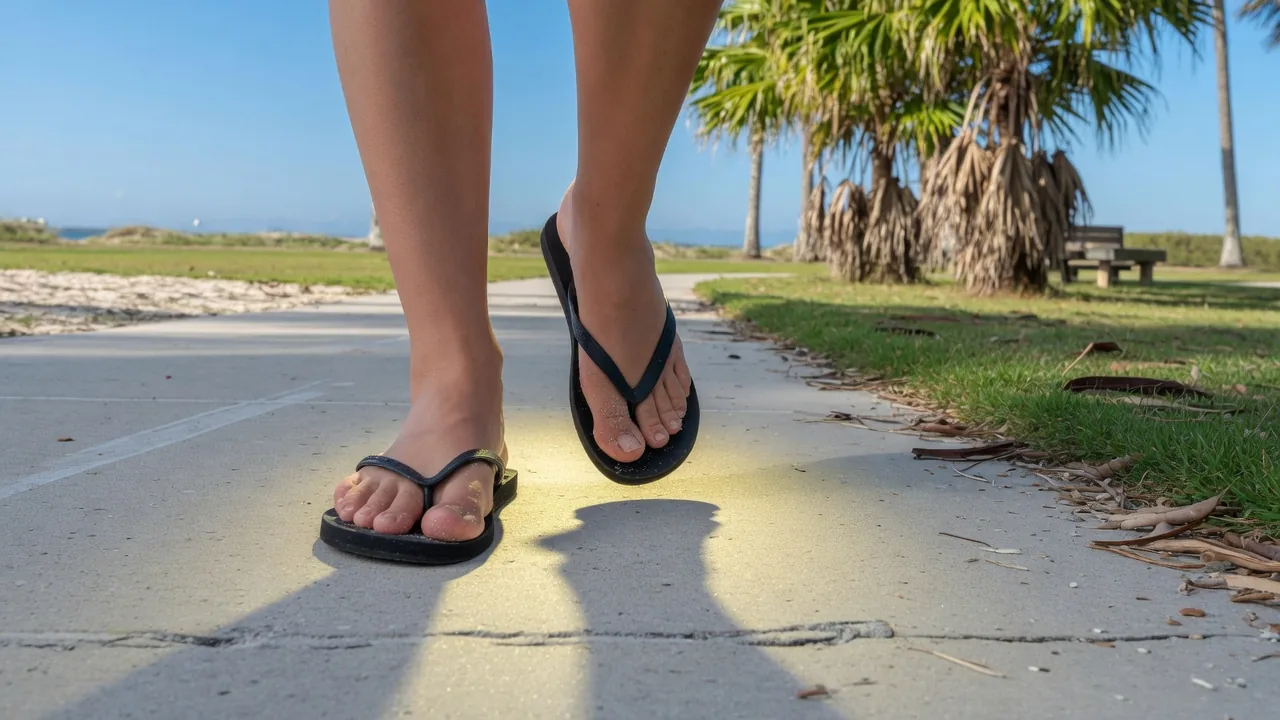
When I ask what's changed, the answer is nearly always the same. A few weeks back the weather warmed up, the work shoes went in the cupboard, and the thongs came out, and not just for the beach. They became the shoe for everything.
It's October in South East Queensland now, and for a lot of people thongs have just become the everyday shoe until Easter. So I'd like to get in before the phone starts ringing and talk about how to keep wearing them without paying for it in December.
I'm not going to tell you to give up thongs
I'm a Queensland podiatrist and I own thongs. Telling people here to stop wearing them would be about as useful as telling them to stay indoors until April.
To be fair to the humble thong, the research is kinder to it than its reputation. A study of children in Sydney found that walking in thongs was closer to barefoot walking than the researchers expected. For a walk to the beach or a quick trip to the shops, a thong is fine.
What causes trouble is the hours. Eight hours a day on tiles and concrete in a flat piece of rubber, week after week, puts a lot more load through the heel than twenty minutes on the sand.
Why your heel takes the hit
A few things happen when a thong becomes your all-day shoe.
Your toes have to hold the thong on. There's nothing behind the heel, so with every step the toes and the small muscles of the foot grip to stop it flying off. That same Sydney study picked this up: the midfoot moved differently as the children worked to keep the thong in place. A few steps of that and nobody notices. Ten thousand steps a day, and in my experience those muscles tire and more of the load ends up on the band of tissue under the foot, the plantar fascia.
There's no cushioning under the heel. A study comparing footwear found that running shoes gave a lower loading rate at heel strike than barefoot, flip-flops or sandals. On tiles and concrete, your heel is soaking up most of each step by itself.
You're on your feet for long stretches. A case-control study of plantar fasciitis found that people who spent most of the workday on their feet were at higher risk, and that tight calves (limited ankle bend) were the strongest risk factor of all. Put long days standing together with a flat, thin sole and you can see why heels complain.
The change is also sudden. Most people go from supportive winter shoes to flat thongs over a single weekend. I don't know of a trial that tests that switch directly, but the timing of the heel pain I see every summer makes me think it matters. Feet seem to cope well with gradual change.
Then there's the lag. The tissue under the foot doesn't complain on day one. It's usually a few weeks in, which is why so many people tell me it "just started" with no idea what set it off.
Heel already sore in the mornings? Come in early, while it's a small problem. We see heel pain at Caboolture, Beenleigh, Browns Plains and Victoria Point.
Book an appointmentDoes this sound like your heel?
- The first few steps out of bed are the worst: sharp, under the heel, and you hobble to the kettle.
- It eases once you've been moving for a few minutes, then comes back after you've been sitting.
- It's worse at the end of a long day on your feet, especially on hard floors.
- The spot is under the heel, often towards the inside edge, rather than at the back.
- It started a few weeks after the weather (and your shoes) changed.
That's the usual pattern. A clinical evidence review by an Australian podiatry researcher describes plantar heel pain as soreness under the heel, sometimes running into the arch, that is noticeable on rising after rest. I've written about heel pain in more detail here, and there's more on the condition itself on our plantar fasciitis page.
Not all thongs are the same
You don't need expensive footwear. You do need to know what to look for.
| Flat rubber thong | Better summer option | |
|---|---|---|
| Footbed | Flat | Contoured, with a shaped heel cup and some arch |
| Sole | Thin, wears flat fast | Thick enough to soften hard ground |
| Heel strap | None, so the toes do the gripping | A strap behind the heel holds it on for you |
| Where it bends | Anywhere, including the middle | Only where your toes bend |
| Best for | Beach, pool, short trips | Longer walks and days on your feet |
There's some research behind the footbed point. One study found a thong with a contoured, shock-absorbing sole cut the loading rate by 19% compared with a standard flip-flop. Fairly small design changes can alter what your heel has to deal with.
A quick test in the shop: hold the thong at both ends and bend it. If it folds in the middle like a piece of cardboard, it isn't giving you much support. Have a look at your old pair too. If the heel has worn down to a thin, flat dent, they've done their time and can go in the bin.
How to keep wearing thongs this summer
- Change over gradually. Mix thongs with your usual shoes for the first few weeks instead of switching completely in a weekend.
- Match the shoe to the job. Thongs for the beach and the shops, and proper shoes for long walks, the dog, the theme park and a day standing at work.
- Don't go barefoot on tiles first thing. Keep a supportive slide or shoe by the bed for those first painful steps.
- Stretch your calves. Tight calves show up again and again as a risk factor, and a daily wall stretch takes a minute.
- Rotate your pairs, and replace them when the heel wears through.
- Keep thongs for the pool deck, where they do protect you from warts and tinea, as I covered in last week's post.
Get it looked at sooner if:
- The heel pain hasn't settled in a couple of weeks, or it's getting worse.
- It's sore at night or when you're resting, not just on standing.
- There's swelling, redness, numbness or tingling.
- It started after a fall or a sudden injury.
- You have diabetes or reduced feeling in your feet. Please don't wear thongs all day without having your feet checked. I explain why in my summer diabetes foot care post.
Most plantar heel pain does settle over time, but the same review notes it can take a long while, sometimes years, and other problems such as a heel bone fracture or a trapped nerve need ruling out. In my experience, people who get on to it early tend to have a shorter, simpler run of it than people who wait until February.
Questions I get asked
Are thongs bad for your feet?
Not in short doses. The problem is long hours in a flat, thin thong on hard ground, where your toes grip to hold it on and your heel gets no cushioning.
Can thongs cause plantar fasciitis?
They can play a part. Long hours on your feet and tight calves are known risk factors, a flat thong gives the heel little cushioning, and I often see heel pain start a few weeks after the switch to thongs.
What should I look for in a thong or sandal?
A contoured footbed with a heel cup and some arch, a decent sole, and ideally a strap behind the heel. It should bend where your toes bend, not in the middle.
Should I stop wearing thongs if my heel already hurts?
Cut them right back while it settles. Supportive shoes for walking and standing, thongs only for short trips, and no bare feet on hard floors first thing.
Are thongs okay for kids?
For the beach and the pool deck, yes. For a full day of running around, a sandal with a back strap or a proper shoe is the better choice.
Can I wear my orthotics in summer?
Not in a thong, but some sandals are built to take an orthotic, and some have a supportive footbed built in. Bring your summer footwear in and we'll work through it.
Sort the heel out before Christmas. We assess heel pain and talk footwear that suits your summer, not just your work shoes, across South East Queensland: Caboolture, Beenleigh, Browns Plains and Victoria Point.
Book an appointmentReferences & further reading
- Chard A, Greene A, Hunt A, Vanwanseele B, Smith R. Effect of thong style flip-flops on children's barefoot walking and jogging kinematics. J Foot Ankle Res. 2013;6(1):8.
- Zhang X, Paquette MR, Zhang S. A comparison of gait biomechanics of flip-flops, sandals, barefoot and shoes. J Foot Ankle Res. 2013;6(1):45.
- Price C, Andrejevas V, Findlow AH, Graham-Smith P, Jones R. Does flip-flop style footwear modify ankle biomechanics and foot loading patterns? J Foot Ankle Res. 2014;7(1):40.
- Riddle DL, Pulisic M, Pidcoe P, Johnson RE. Risk factors for plantar fasciitis: a matched case-control study. J Bone Joint Surg Am. 2003;85(5):872-877.
- Landorf KB. Plantar heel pain and plantar fasciitis. BMJ Clin Evid. 2015;2015:1111.
- Koc TA Jr, Bise CG, Neville C, Carreira D, Martin RL, McDonough CM. Heel pain - plantar fasciitis: revision 2023. J Orthop Sports Phys Ther. 2023;53(12):CPG1-CPG39.
- Australian Podiatry Association. podiatry.org.au.
This is general information, not individual advice. If your heel pain is severe, getting worse, or not settling, have it assessed by a podiatrist or your GP.